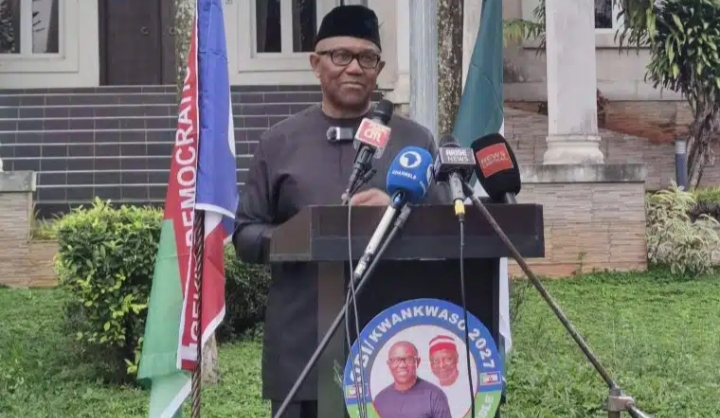
As Campaigns for the 2027 Presidential and National Assembly elections commence, the presidential candidate of the Nigeria Democratic Congress (NDC), Peter Obi says his campaign will focus on the urgent concerns of Nigerians and not on ethnicity or religion.
Addressing Nigerians via a news conference on Friday, Obi opined that the 2027 election must be guided by capacity, competence, compassion, character, and commitment.
The former Anambra state Governor therefore charged Nigerians to reject and disregard any campaign driven by propaganda, ethnicity, religion, elitism, or cronyism.
“As my team and I travel across the country, we will listen to Nigerians, understand their needs and concerns, and assure them that we have the competence, character, and compassion to lead and reset Nigeria for the benefit of all.
“Nigerians deserve leaders who will engage them, listen to their concerns, and present clear solutions to unite the country, defeat insecurity, pull people out of poverty, drastically reduce hunger and the number of out-of-school children, improve education and healthcare, and build growth that serves everyone, especially the most vulnerable. Every candidate must be willing to present their credentials, defend their records, and subject their vision to open scrutiny.
“No candidate should hide behind the high walls of power, send proxies or surrogates to the husting, and expect Nigerians to entrust them with the leadership of the country. Every candidate seeking the presidency must have the courage to come before the people, answer their questions, defend their records, and subject their vision to public scrutiny.
“True leadership requires presence and empathy. No one can lead from the front without standing with communities across Nigeria devastated by banditry, criminality, terrorism, and flooding. You cannot truly lead people you are unwilling to visit, listen to, and understand.
The NDC Presidential candidate assured that together with his running mate committed to commencing the journey of resetting Nigeria by uniting it, securing it on the path of economic and inclusive growth, and moving our country from consumption to production.
While expressing concerns that Nigeria faces several serious challenges,Obi pointed out:
“According to the IMF, 63%, or over 140 million Nigerians, live at or below the national poverty line, while humanitarian agencies estimate that 35 million people will need food assistance during the 2026 lean season. About 3.6 million Nigerians remain internally displaced, largely because of conflict and insecurity. Each year, millions of young people enter the labour market, yet too many struggle to find productive opportunities. Weak infrastructure, unreliable power, insecurity, and the excessive cost of doing business continue to burden households and constrain enterprise.
“These are more than statistics. They reflect the daily realities of Nigerian families, farmers, workers, students, and businesses.
“Yet I do not believe Nigeria lacks the ability to overcome these challenges. We have the people, resources, market, talent, and enterprise. What we must do now is turn these strengths into security, productivity, and shared prosperity.
“My successful private-sector experience, studies in institutions of repute on policy and business matters, and my service as Governor of Anambra State have shaped my understanding of public leadership. Government must manage resources responsibly, set clear priorities, and measure the outcomes of its decisions. Public office is not a reward; it is a responsibility to the people.
On the economy, the former Anambra Governor made it clear that Nigeria needs more than reactive reforms and assured that an NDC Government will create a business environment where entrepreneurs can invest, hire, and grow without unnecessary regulatory or infrastructure barriers.
“We must focus on the questions that matter.
Are Nigerians better off than they were four years ago? Can they afford food, education, and healthcare? Can businesses produce, expand, and create jobs? Can young people find productive work? Can farmers work safely and get their produce to market?, he queried.
He further vowed to raise agricultural productivity by securing farming communities, expanding irrigation, improving rural roads and storage, and linking farmers to finance and markets as well as strengthen manufacturing and agro-processing so Nigeria can export more finished goods and capture greater value from its resources.
On security, Obi while lamenting that millions of Nigerians have displaced resulting in the disruption of agriculture, education, trade, and investment, assured that his administration will improve intelligence gathering and coordination among security agencies, strengthen policing and border management, and make better use of technology.
“Security policy must also address the conditions that make vulnerable young people susceptible to criminal recruitment. Farmers cannot produce food if they cannot reach their farms safely. Children lose the chance to learn when they cannot attend school safely. Businesses cannot create jobs when they cannot move goods securely,” he noted.