
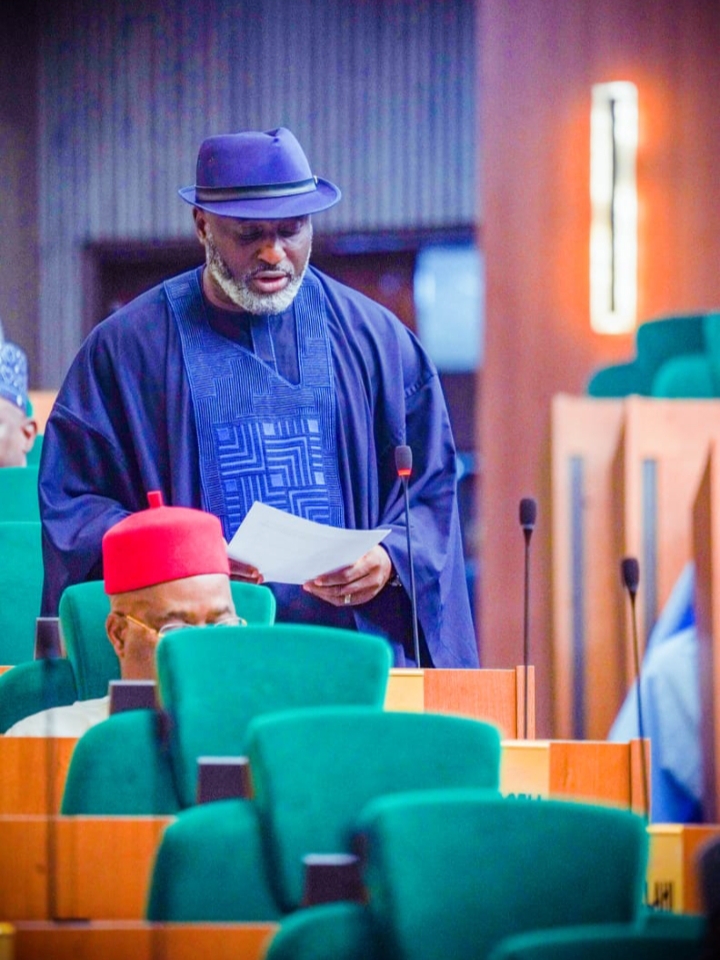
Member Representing Isuikwuato/Umunneochi Federal Constituency, Hon. Amobi Godwin Ogah, has introduced a bill seeking to establish a 50-year National Economic Plan for Nigeria.
Presenting the bill, Ogah said it is aimed at addressing the country’s long-standing challenges of policy inconsistency and short-term development planning.
According to him, the proposed legislation, titled “A Bill for an Act to Institute a Fifty-Year National Economic Plan for Nigeria (2026–2076) and Measures to Compel Compliance and for Related Matters (HB. 2488)”, is designed to provide a legally binding framework that will guide Nigeria’s economic development across successive administrations.
While observing that Nigeria had in the past struggled with implementing such policies, the National Assembly member cited past initiatives such as Vision 2010, Vision 20:2020, and the Economic Recovery and Growth Plan (ERGP), which, despite their ambition, fell short due to weak institutional frameworks, frequent policy reversals, and lack of legal backing.
He made it clear that the new bill seeks to correct these structural deficiencies by institutionalizing a long-term development strategy that ensures stability, accountability, and coordination in economic management.
He explained that a 50-year economic plan would promote macroeconomic stability by providing clear fiscal and monetary direction, reducing uncertainty, and strengthening investor confidence.
The lawmaker added that such a framework would also encourage long-term investments, particularly in capital-intensive sectors like infrastructure, manufacturing, and energy.
Hon Ogah further emphasized that the bill would help curb the persistent issue of abandoned projects by ensuring continuity in government policies and development programmes.
He noted that infrastructure projects such as roads, railways, power, and ports require sustained planning and investment beyond short political cycles.
The proposed legislation also seeks to align Nigeria with global best practices in long-term economic planning. Countries such as China, India, and Malaysia, as well as African nations like Rwanda, Botswana, and South Africa, have adopted similar long-term strategies to drive economic transformation. It also complements the African Union’s Agenda 2063 development framework.
Key objectives of the bill include establishing a binding national economic plan, ensuring policy continuity, promoting diversification of the economy, strengthening institutional coordination, and introducing compliance and enforcement mechanisms for government agencies.
Describing the proposal as a critical structural reform, Hon Ogah therefore urged his colleagues to support the bill as it advances to second reading, stressing that it would reposition Nigeria for sustainable growth and global competitiveness.


